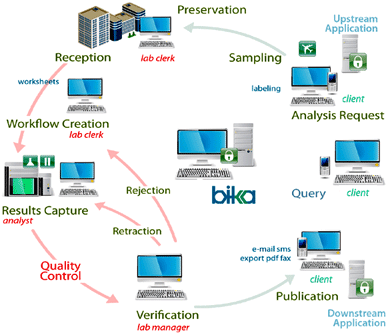
LABORATORY INFORMATION SYSTEM (LIS)

What is laboratory information
system(LIS)?
-Is the computer software that processes
stores and manages data from all stages of medical processes and testes .
Physicians and laboratory technicians
use laboratory information systems to coordinate varieties of inpatient and
outpatient medical testing ,including hematology ,chemistry, immunology
microbiology.
OPARATION OF LIS
The LIS should incorporate advanced
administrative and financial functionalities ,including the following:-
1.
Ability
to generate and transmit the necessary forms and notification for
reimbursement of test ,with the appropriate test cord.
2.
Tracking of costs of laboratory operation
,including consumable ,labor, amortization, and other fixed costs
3.
Analysis
or pricing, profitability,
”make-or-buy” decision tools and at reach client management capabilities .
4.
Workload statistics based on system variable
such as time logged in, number of test verified, and instrument raw test
counts, as well as inputs.
5.
The system have enough capacity to record large
datasets and interface with legacy system to capture historical laboratory
data, with the goals of storing lifelong result on each patient.
6.
The system should capture industry standards for
coding, billing, documentary generation, and interface formats such as CDC.
7.
The user interface and navigation should be
intuitive and user friendly.
FEATURE OF LIS
LIS-are listed
under the following sections such as:-
§
Information security
§
Test ordering
§
Specimen collection, Accessioning and processing
§
Analytic phase
§
Result entry and Validation
§
Resulting reporting
§
Notification management
§
Data mining and correctional reports
§
Method validation
§
Quality Management
§
Administrative and financial Issue
TO PRODUCE REPORTS
The system should
be able to provide a variety of reports for use in patient care, include
standard and user definable reports organized by test, test group, date, date range,
ordering provider or provider group, clinic or specialty and sequential or
tabulated cumulative worksheets.
SAMPLE LABELING
Purpose
This policy
defines labeling requirement for acceptance of samples by laboratory personnel
and defined criteria for rejection of samples in the routine setting.
How to label?
1. Specimen must be labeled for prevent any hazard in the
laboratory, ensure:-
Before collecting/labeling the
sample, the patient identity must be confirmed: If any discrepancy in patient
identification exists, it must be resolve before collecting the sample .
Confirm identity by either;
a)Inpatients ; Emergency surgery :comparing the computer
generated label, or requisition to the patient wristband.
b)Out patients; having the patient state his/her name and
DOB.
2. Label the sample in the presence of
the patient with complete patient.
3. If multiple sample, label with
numbers(preferable) or letters.
4. If the source is lengthy , use number
or letters with an a bloviated source on the container.
5. Label full patient name
6. Label data , time of sample
collection.
How to capture?
The manual label should be used for
capturing patient and Laboratory information by using paper .
All information in the laboratory captured with paper,
information which needed to captured in a paper are:-
·
Patient
information
·
Equipments
ant Instruments information
·
Test
result s
·
Management
information
Also
some information captured to the electronic device such as computer.
Ø The computer should identify all
specimen which received in the laboratory without an order or accession , but
with appropriate patient identifiers.
Ø The system as ability to present the
collector with list of pending laboratory orders and generate unique bar-corded labels to the bedside upon
scanning the patient identification wristband or other unique physical patient
identifiers.
Ø The
system should have the ability to de-identify and codify specimens for search purpose , and
include database management capabilities for bio banks and tissue repositories.
How to save result?
The LIS
should not only serve as a repository of laboratory result generated by the
analytic process , but also guide the analytics into providing high-quality
results that are accurate , reproducible , and appropriate to the clinical
situation.
Before save
result ensure that all information should be well to help quality performance
in the laboratory.
Conclusion
Laboratory information system can improve laboratory
operations and improve patient care.
Reference
1.
Termurtas
F.A Comparative study on thyroid disease
diagnosis using neural networks .expert
syste App .2009;36(1) :944-949.
2.
Le
QA, strylewicz g,goctor JN. detection